Wednesday, July 5, 2017

Interview Series: German Hornsound

Welcome to the first life after "horn ensemble from around worlds" era post! 

The first HOT's topic today is part of "Interview Series" where I would share some interviews that I made throughout the year. These interviews were, again, part of some of the courses I took last year. There were, of course, some requirement or theme but it didn't stop me from wanting to know a little more in the area that I would learn and would be good for other people to know as well! So far, I have 7 interviews in stock and I will slowly post them by the end of July!

Here we go. 

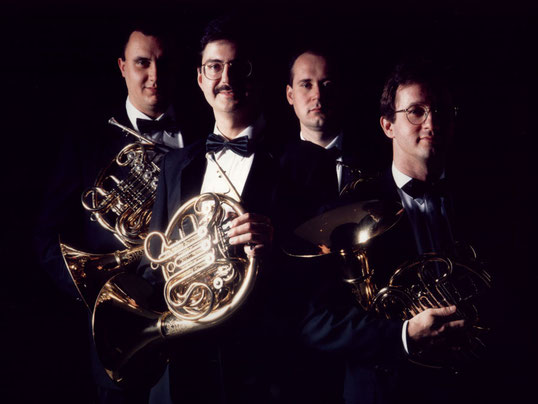
I would like to begin with the great German Hornsound

(L to R. Stephan Schottstädt, Timo SteiningerSebastian Schorr, and Christoph Eß) 
Why do I interest in them?
While I was doing some research online, a Facebook video of the ensemble’s interview in Hong Kong came up. I have learned of this ensemble probably last year or two years ago through, again, a Facebook video (see below). It was one of their creative performance (acting + performing with narrator). Since I am interested in finding different ways in giving performance, I decided to interview them. I was also quite confident that they would at least response to my message on either Facebook or e-mail as they are active on social media. They replied my message within one day to let me know that they are agreed to do the interview. As the ensemble is becoming more successful it would be interesting to learn about administrative and management aspects rather than rehearsal and performing aspects. 

Besides, don't you want to know any other horn quartets apart from the American Horn Quartet? 

Hence, my questions are based on above idea.

Here is a brief history of the ensemble.
The German Hornsound is a horn quartet base in Germany. The ensemble was founded in 2009 (according to their website but 2010 according to its member) by four international recognized German hornists who graduates from Hochschule für Musik und Darstellende Kunst Stuttgart, studying under Prof. Christian Lampert. The ensemble have appeared in many music festivals in German speaking country and have recently made successful debut performances in Asia.
Apart performing original works or arrangements for horn quartet, the German Hornsound is famous for developing their own program. In 2013, the ensemble developed “Siegfried & Violeta“ a three-act opera fragment based on theme by Verdi and Wagner for four horns and speakers. They have commissioned and premiered a new work for four horns and orchestra by Oliver Tardy in the same year.
More information can be found from their website or Facebook page.

Interview Summary 
(You may choose to skip this summary for a full script of the interview which can be found below this summary)
The interview questions were answered by Christoph who is a member of the group as well as acting as a group manager. It is to learn that the group was formed not with an idea to have a professional group but rather to have fun making music together. After gave their first performances in 2011/2012 season, they became famous (partly due to their profiles and reputations, I believe) and started to have more engagement where they reach about 30 concerts a year. Their ensemble philosophy is a homogenous and warm French Horn sound combined with their own creative concept productions. Since they came from the same teacher, it is not too difficult for them to have a similar concept of sound to achieve the homogenous sound. Concepts, however, can be different. The ensemble take their friendship as a priority. When different opinions occur, they solve their differences by talking together. This diminish communication problems.
The ensemble registered as a company and became official in 2013 when they reached 20 concert a year. Apart from Crownfunding their first recording in 2012, German Hornsound’s budget comes from benefits of their merchandises, productions, and other investments. This proves how succesful they are. Part of their success comes from their creativity and originality in their programming. Not only playing standard repertoire or arrangement for horn quartets, they create a theme performance around different arrangements such as Siengfried und Violetta: Opera fragment based on arrangement from music of Richard Wagner and Giuseppe Verdi or program for children - “Wie die Musik um ein Haar flöten ging” and “Auf die Hörner, fertig, los!” where we play the music and act the roles. Apart from performing in concert halls, German Hornsound also oftenly perform in school during music lessons. Not only the students would be excited about the instrument, it is a chance to meet the future generation and to obtain their interest in classical music so they can continue support classical music. The group think that, this should be a duty.
Another important aspect is to be active in social media in order to maintain an interesting image to audience as well as concert promoters, and agencies. It can be short video clips, pictures, or stories. Personally, I think they have used it effectively. The advantage of having full-time orchestra jobs provide them opportunity to take more risks in experimenting new things. Since their are fewer horn quartets out there especially after American Horn Quartet has retired, they wish to bring French Horn music to the audiences and to show how wonderful the instrument can be.

Their last word of advice is “Every musician is different. You have to find your own way of playing an instrument and performing concerts. You have to do this with self-confidence, but never stop learning from other great musicians.“
_________________________________________

I would like to sincerely thanks Christoph  and the German Hornsound for their time and for sharing their experiences. And to my dear reader, I would love to hear your thought!

See you next post!


__________________________________________

Full interview transcript with German Hornsound

Questions:
1. How was the ensemble started? What was the aim? What is your ensemble philosophy?
The ensemble was founded by four german graduates of the French Horn Class of Prof. Christian Lampert at the State University of Music and Performing Arts Stuttgart in 2010. Actually, the original idea was to spend more time together, to have fun and make music.  After we finished our studies, we drifted apart in four different cities; Berlin, Bamberg, Hannover and Reutlingen and didn’t see each other very often. So we organized a few concerts in 2011/2012. We never expected to go this far of having about 30 concerts a year. Our ensemble philosophy is a homogenous and warm French horn sound combined our own creative concept productions.

2. Were there any official process of setting up an ensemble? If so, what were they? Did you have to register it as an organization? Is it easier to set up a professional ensemble in Germany? Who runs the ensemble?
The ensemble became official in 2013 when we reached the level of  more than 20 concerts a year.  We had to register as a Company. All four of us are equal partners in the company.

3. How are you being funded or supported? Is the ensemble being funded per year? Do you need to find your own sponsorships or patrons?
We just took a chance on Crowdfunding for our first recording in 2012. Since then ,the ensemble hasn't need any patrons or sponsorships and we take the expenses and investments for our productions, merchandising, tours e.g. out of our own incomes.

4. Why should there be another professional horn quartet? What make a successful ensemble?
That is a good question. In our opinion, there are not many Horn quartets, which perform as frequently as we do. Most of the existing quartets are members of orchestral horn sections which perform only a few concerts per year.
Our aim is to create original programs and tour through Germany and Overseas. Since the American Horn Quartet has retired, there are fewer quartets.
You can be successful with this special Instrumentation, when you take a chance at offering interesting programs to the festival and concert series promoters.

5. What is your thought process in creating a performance program? How do you manage your relationship with different types of audience? (I was really impressed by watching your "Wie die Musik um ein Haar flöten ging" Video!)

We offer quite a lot of different programs. On the one hand there are soloistic pieces for four horns and Orchestra. We often played Schumann concert piece and the new piece written for us in 2013 by Tragve Madsen. Then we have our concept programs (sometimes with singers, with actors, with authors).
We have two different education programs for children (“Wie die Musik um ein Haar flöten ging” and “Auf die Hörner, fertig, los!”) where we play the music and act the roles. And last but not least, we have programs just for horn quartet.
But the creation process for all our programs is begun by thinking about which music is arrangeable for our instruments.  Then we create the program around the arrangements. Each of us takes part in the process of making the arrangements, the stories, art work and marketing.

6. What was your latest experience in Asia like? Are there any differences between audience there and in Europe? What else did you learn?
Our debut in Asia two weeks ago in Hongkong and Taipei was absolutely amazing. We had three fantastic concerts. The audience was very friendly and polite. Almost all of them wanted to have pictures with us, and they bought our CDs and merchandising products with our autograms. We met wonderful people and learned that the French Horn society all over the World has a strong sense of togetherness.

7. As a musician, are there any benefits from involving with or taking part in different community?  If so, what do you think the ensemble role is in the community?
We are very often playing in schools during the Music lessons. The young pupil are very excited about the French Horn, about Classical Music in general, about being a professional Musician. And also for us there is a big benefit to meet the future generation directly which we absolutely need tob e interested in classical music, to go into the concerts. For any ensemble this should be a duty!

8. As social media has become part of today’s life; how important it is to be active online? Would this model change in the future?
That is something we also learned last year, especially with our contacts  in Asia. Being active online and in social media is very important. You should keep your followers always up to date with little videos, pictures, and stories. But it is also important to keep concert promoters and agencies up to date and maintain an interesting image.

9. What are the problems that the ensemble has encountered so far and how do you solve them?
For us, the friendship between the four of us is a priority. That is our basis and is still a constant factor. So, we don't have communication problems. Of course we have different opinions in some things but we always solve our differencses with direct communication.
Sometimes we have, of course, musical decisions to make. There are different ways of playing, of articulating, and of phrasing. But we always reach a solution and solve these problems by talking together.

10. What is the ensemble goal for the next 20 – 30 years?
Of course we want to maintain it as it is. We have one big advantage compared to string quartets or other famous chamber music ensembles and that is ,we have our orchestra jobs and can play quartet just for fun on the side. So sometimes we take more risks in investmenting in some crazy things for our productions. Our experience has shown that effort (time, money, ideas) is always worth it. We want to bring French Horn Music to the audiences and show how wonderful our instrument can be!

11. Any word of advices for young professional musicians who are about to go to into a ‘real’ world?
Every musician is different. You have to find your own way of playing an instrument and performing concerts. You have to do this with self-confidence, but never stop learning from other great musicians.
______________________________________

P.S. I was told that I forgot to give an answer to the trivia I wrote from Feb 2, 2017 post. Here we go!

The highest note from orchestral literature is the E above high C which can be found in R. Strauss' Sinfonia Domestica, Op. 53 and the lowest note is the pedal E that can be found in D. Shostakovich Symphony no. 5! (however, I have a feeling that my answers might not be up to dated any more. So, I don't mind if I am wrong so that I can learn something new!)


May the horn sound be with you!


Monday, July 3, 2017

Table of Content from 'Horn Ensemble Around the World' time!

Hello again! It has been a long time since my last post. I would like to take this opportunity to welcome my old and new readers!

For those who don't know, this blog was part of Advanced Brass Ensemble Literature (ABEL) I mentioned above and it needed to focus on one theme so I chose 'Horn Ensemble Around the World'. Since I am done with the class, it is time that I can start to share more interesting and fun stuff! Before doing that I would like to use this blog to list out all previous blogs so you can enjoy!

Content from ABEL
1. Welcome
2. Playlist from Today's Listening Presentation

Extremely Brief History of Horn
1. Hunting Horn
2. Horn in Orchestra

Horn Ensemble Series 
1. Berlin Philharmonic Horns
2. Horn Ensemble Series: the London Horn Sound
3. Horn Ensemble Series: the Vienna Horns
4. Horn Ensemble Series: a fight back from the London Horn Sound!
5. Horn Ensemble Series: What happen after 'Give it one'?
6. Horn Ensemble Series: a Story of Horn Pure
7. Horn Ensemble Series: American Horn Quartet
8. Horn Ensemble Series: Transatlantic Horn Quartet
9. Horn Ensemble Series: Budapest Festival Horn Quartet
10. Horn Ensemble Series: Professional Horn Quartet Today

Personal Interest
1. Thoughtful Monday: 12 hours without music
2. Re-thinking Brass Ensemble: Brass Music from other culture?

See you next post!

Sunday, April 23, 2017

Re-thinking Brass Ensemble: Brass Music from other culture?

In our last ABEL class, Prof. Manning presented brass music from other cultures and asked all of us to post a blog of brass music from other cultures to share with others. Well, I was thinking of doing a post about 'Brass' ensemble anyway.

In my very first blog post, I defined 'horn' and 'ensemble' but never did define brass. Here it is.

According to Meriam-Webster, Brass means

1. an alloy consisting essentially of copper and zinc in variable proportions
2. a :  the brass instruments of an orchestra or band —often used in plural
    b :  a usually brass memorial tablet
    c :  bright metal fittings, utensils, or ornaments
    d :  empty cartridge shells
3. brazen self-assurance
4. singular or plural in construction
  1. a :  high-ranking members of the militaryb :  persons in high positions (as in a business or the government)
As a musician, our mutual understanding of 'brass' is the 2nd definition that the instrument in brass family are made of brass. What about saxophone then? Well, it is a woodwind instrument because it uses wooden read to produce sound. Sure, clarinet, oboe, and bassoon use the same thing. What about flute? One can argue that flute used to be made of wood so it counts as a woodwind instrument. 

Let's go back further in time. The origins of most instrument came from natures such as animal horns or seas shells.


I know this is not brass instrument but if we consider how today's instrument built, shouldn't flute or saxophone be part of the brass instrument? or even vibraphone?

Now my 'Brass' ensemble is a little broader which allow us to enjoy more type of music from brass such as music from South East Asian traditions. Here the example of Gamelan music

Here is the introduction to Gamelan music.


And here are some Gamelan music.


Of course, there are other instruments in South East Asian tradition that are made of brass as well. 
Such as Kong Wong - an instrument consists of tuned gongs. It can be divided into two types - Kong Wong Yai which consists of 16 tuned gongs in a lower pitch (Yai means big), and Kong Wong Lek which consists of 18 tuned gongs in a higher pitch (Lek means small). 

Kong Wong Yai

It would be interesting to see a mixture of western brass instrument playing with other traditions brass instrument. What I can find so far is the Double Concerto for Violin and Cello with Javanese Gamelan Ensemble by Lou Harrison. Very interesting piece!


Sometime we are afraid of loosing our identity which blocks our creativity. Of course, we all need to know and to have basic understanding of things we want to explore first. Once we know where the boundaries are, we can then start to find a way to reshape it or even to melt it down so that we can create something new. 

In today's music world, classical music has arrived the point that it starts to get stuck. Once we get stuck, human's instinct yearn for something new hence new creation, new types of music. Keeping tradition is good and it should be kept and supported but, as we all know that things that can't evolved to the new setting extincts, classical music needs to be evolved too. That is why we can now see many new ways of presenting music which is a good thing.

For this last 'official' post for Advanced Brass Ensemble Literature class, I would like to end with a quote by Charles Darwin:

“Thus, from the war of nature, from famine and death, the most exalted object which we are capable of conceiving, namely, the production of the higher animals, directly follows. There is grandeur in this view of life, with its several powers, having been originally breathed into a few forms or into one; and that, whilst this planet has gone cycling on according to the fixed law of gravity, from so simple a beginning endless forms most beautiful and most wonderful have been, and are being, evolved.”   

Extra: This is how western brass musical instruments have been evolved and used in Thai traditional ceremony.


Monday, April 17, 2017

Horn Ensemble Series: Professional Horn Quartet Today

Even though the American Horn Quartet has ended their journey, the Budapest Festival Horn Quartet, and the Transatlantic Horn Quartet do not perform as much as they used to, there are still some professional horn ensembles out there. They are Genghis Barbie, Leipziger Horn Quartet, and the German Hornsound - the latest addition to the horn quartet world.

I learned of Genghis Barbie from an article on Facebook and I am glad I found them! The group was founded in around 2010 by Alana Vegter, Danielle Kuhlmann, Leelane Sterrett, and Rachel Drehmann - 4 female hornists in New York City. They are considered, according to their website, the leading post post-feminist feminist all-female horn experience. Their repertoire includes arrangements of pop music from the 70's, 80's, 90's and today, contemporary commission, and classical works. They have released four studio albums: the self-titled debut album, the holiday album "Genghis Barbie: Home for the Holidays," "Genghis Baby: Songs for Noa," and the newly released "Amp it Up!" Genghis Barbie aspires to appear on the Ellen DeGeneres show within one calendar year.

Sweet Dreams (Are made of this) by Genghis Barbie

Above video is one of how innovative and creative they are. They definitely know where the untouched land is and they can obviously do it really well. They even have their own stage name!

  • Alana Vegter aka Freedom Barbie - a graduated from Julliard and was a substitute Assistant Principal Horn with New York Philharmonic 2014 - 2015 season.
  • Danielle Kuhlmann aka Velvet Barbie - a graduate from Julliard and Rice University. Currently 2nd horn with San Diego Symphony Orchestra
  • Leelanee Sterrett aka Cosmic Barbie - a graduate from University of Wisconsin -  Madison and Yale University. Currently 3rd horn with the New York Philharmonic Orchestra
  • Rachel Drehmann aka Attila the Horn - a graduate from University of Minnesota and the Manhattan School of Music. Freelance in NYC.
Enjoy their videos on their YouTube channel HERE.
________________________

Leipziger Horn Quartet is a more traditional oriented horn quartet comparing to the Genghis Barbie. The members are from orchestra in city of Leipzig in Germany. According to their website, they were formed in 1951. Even though members changed, the group have never disappeared. 

The group current members are all from MDR Symphony Orchestra (formerly known as Rundfunk-Sinfonieorchester Leipzig)
  • Max Hilpert - Solo Horn of MDR Symphony Orchestra 
  • Tino Bolk - Solo Horn of MDR Symphony Orchestra
  • Johannes Winkler - Horn of MDR Symphony Orchestra
  • Michael Guhne - Horn of MDR Symphony Orchestra

They have recorded 6 CDs. The latest CD is called "Romantische Hornquartette". Below is a track from this CD. The distinct sound of German horn playing (brighter and "Alexander 103" sound) can be heard clearly in this recording. 

Quartett für vier Waldhörner in E-Flat Major, Op. 19: IV. Alla Pollacca - Monore - Maggiore 

If you want to hear more of them, go HERE
________________________

German Hornsound is the latest addition to horn quartet world. I will talk about them and what I learn from their interview in the next post!

Saturday, April 15, 2017

Horn Ensemble Series: Budapest Festival Horn Quartet

Playing chamber music with your colleagues is not only socially and musically fun, it helps bonding sectional playing as well. Once the section is strong and everybody know their respective duties, it only helps each member to become stronger both as a group and an individual.

Berlin Philharmonic Horns and its Four Corners was a good example of a group of horn quartet that came out of an orchestra (from Berlin Philharmonic Orchestra of course).

Budapest Festival Horn Quartet consists of four horn members of Budapest Festival Orchestra in Hungary. Founded in around 1983 by Ivan Fischer, the orchestra comprises of young and upcoming musicians in Hungary. Since then, they have become one of the world sought after orchestra

Budapest Festival Horn Quartet members are from the Festival Orchestra led by Miklos Nagy who is the principal horn of both the Festival Orchestra, and the Luxembourg Philharmonic Orchestra.

According to Nagy (click HERE to read Nagy's interview), the inspiration of this ensemble was after they had heard American Horn Quartet in Barcs competition. They were very active during mid 90's up until around 2010 in which they released two CDs. There are some distinct styles in their playing which separate them from the American Horn Quartet. They are also technically amazing and can play everything with ease.


Explore their YouTube channel HERE for some more amazing playing!


Wednesday, April 12, 2017

The Great Listening Party

Our annual listening party is back and is the last one of this semester if I am not wrong.

The class started by Prof. Manning playing us German Brass live performance of  John Baston, arr. Matthias Höfs, "Allegro" aus Konzert in D-Dur. The German Brass is still the German Brass. The ensemble playing is just as neat as always. No further explanation needed. Enjoy!


Kenken was the first volunteer. He played for us, Anthony O’Toole – Elegy for Brass and Percussion.
Anthony O'Toole is a graduate of Indiana University of Pennsylvania and George Mason University. He composes music for different type of instrumentation but his majority are for Wind Band.

Elegy for Brass and Percussion, O'Toole said "This work is an adaptation of another work of mine (Pastorale) which I did for the 15th anniversary of 9-11. Premiered by the Southern California Brass Consortium, Hector Salazar conducting."

Please follow this LINK for the recording!


Marc gave us Alfred Reed’s Symphony no. 1 for Brass and Percussion (4 trumpets 2 cornets 4 horns 4 trombones 4 euphoniums 2 tubas 5 percussions) performed by Hora Decima. For winds and percussion players, we all know how much Alfred Reed contribute to those instruments. This symphony is declared Symphony no.1 when he passed away few years ago.  

Here you go!


chose Sandor Balogh’s Weltreise performed by Berlin Philharmonic Brass Ensemble (for 5 trumpets, 1 horn, 3 trombones, 1 baritone, 1 tuba, percussion and a moderator). Balogh is a member of Budapest Festival Orchestra in Hungary. According to Budapest Festival Orchestra's website. "He pursues a wide-ranging activity also as a composer. He has orchestrated and arranged a lot of compositions of lighter music to different instrumental groups, ranging from string quartet to symphony orchestra. As a composer he won several prizes at international competitions of radio stations: 1995 Monte Carlo - 1st prize, 1997 Brno - 2nd prize, 2001 Shanghai - 3rd prize".

According to the Digital Concert Hall's program this piece is "...Together with the musicians you can roam countries both near and far, from Austria to Japan, and from Argentina to the United States. In each country there are characteristic sounds and melodies, arranged and composed by Sándor Balogh [which become Weltreise (German means World Travel)]..."

The performance was part of the educational/family concert by Berlin Philharmonic Orchestra. This concert is archived and anybody can access to this concert without any charge HERE. I think this shows how music is involving and trying to keep up with the world.


Anna played for us Eric Ewalzen’s Shadowcatcher for Brass quintet and wind ensemble. This recording is performed by the Western Brass Quintet which comprise of faculty from Western Michigan University with Western Michigan University Wind Ensemble. (Anna was playing with the wind ensemble which was recorded in 2013!) 

There are four movements in this piece: I. Offering to the Sun, II. Among the Aspens, III. The Vanishing Race, and IV. Dancing to Restore an Eclipsed Moon.

Please follow this LINK for the Western Brass Quintet recording. If you don't have Spotify, YouTube does have a recording by American Brass Quintet and Julliard Wind Ensemble. Here is the first movement!


Caleb played for us, Lansing McLoskey’s Madding Crowd for brass quintet performed by Triton Brass. This piece comprise of six miniature movements which entitled I. Intro, II. Part 1., III. Part 2, IV. Part 3, V, Part 4, and VI. Part 5. Each instrument of the brass quintet are featured in each movement (part) of this piece. It was commissioned by Triton Brass and was premiered in 2007 at Tanglewood Institute.

It is a really good contemporary for brass quinete, I thought! Here is the example of the piece!


Evan was the last person who presented today! - Henri Tomasi's Suite for Three Trumpets. This suite was composed in 1964. The three movements are I. Tempo di Habanera, II. Len égéen and III. Danse Bolivienne. 

Here is the 3rd movement.


Encore
While searching for above videos, this came up. It's a video recording of Philip Cobb, principal trumpet of the London Symphony Orchestra, and the Royal Concertgebouw Orchestra Brass Ensemble. Philip Cobb is back on cornet, the instrument he started with!

Have a great day!


Thursday, April 6, 2017

When your professor is away: Listening Party 2

Yesterday we had our second listening party while Prof. Manning was away on his solo tour.

Here are the list of what we listened to!

Anna chose for us - J.S. Bach: Fugue in D minor (Original in G minor) Arr. Mexi
performed by Budapest Festival Horn Quartet which comprise of Miklos Nagy, Laszio Rakos, Laszio Gal, Tibor Maruzsa. 

This piece is an arrangement of J.S. Bach's "Little" Fugue in G minor BMV.578 into a more fitting key for horn in D minor performed flawlessly by the Budapest Festival Horn Quartet. They are no stranger to the horn world. The member are from the Budapest Festival Orchestra found by Ivan Ficsher. I will talk about them in more detail in the next post.


Kenken played Benjamin Blasko's Victory Fanfare performed by Tromba Mundi with Messiah College Wind Ensemble conducted by Bradley Genevro.

This piece is for solo trumpet ensemble with wind ensemble. This Fanfare is a good opening song for any program. It could also be a good showpiece of any ensembles that have a good trumpet section as well.

Here is the link to the piece!

Marc presented Karel Husa's Divertimento for Brass and Percussion performend by University of North Texas Brass Choir conducted by Eugene Migliaro Corporan.

This divertimento consists of four movements: I. Overture II. Scherzo III. Song IV. Slovak Dance. It is composed for 4 Horns, 3 Trumpets, 3 Trombones, 1 Tuba, and 2 Percussion. Marc told us that there is also a version for Brass Quintet.

Here is the first movement.


Evan played for us a very interesting piece. Ellen Taffe Zwillich composed Clarino Quartet for Piccolo Trumpet, Eb Trumpet, and 2 C Trumpets. The recording performed by Thiery Gervais and (my guess) Ensemble de Cuivres et Percussions des Solistes de Paris.

The name of the piece itself already draw me in and I wonder how Zwillich Clarino's idea turn out.

Here is the recording of the piece!


Film music always has Brass moments. Caleb showed us exactly that by playing Quidditch theme from Harry Porter composed by John Williams performed by Boston Symphony Brass. Caleb also said that this is a good encore piece.


Lastly, I played Alec Wilder's Jazz Suite for Four Horns, Harpsichord, Guitar, Bass, and Drum
This piece consists of four movements: I. Horns O'Plenty II. Conversation Piece III. Serenade IV. Horn Belt Boogie.

This piece has a very interesting combination. Harpsichord for Jazz?! It is a brilliant idea and it actually fits really well to the style. To me, it sounds like harder and thicker string guitars.

This recording is performed by Charles Tibbetts, William Hovt, David Kappy, and Ricardo Almeida on Horns - Vincent Fuh on harpsichord, and Henning Backhaus on guitar, bass, and drum!

Enjoy!